


Amazon Air Expands Widebody Fleet To Boost Logistics Capacity
Apr 08, 2025
Leave a message
Amazon Air Expands Widebody Fleet and Nocturnal Operations to Boost Third-Party Logistics Capacity
Amazon Air is enhancing its widebody cargo capabilities to support growth in third-party logistics, according to new research from the Chaddick Institute at DePaul University. The carrier has shifted operational strategies, including expanding nocturnal flights and replacing shorter routes with truck-based deliveries, while prioritizing the US market following reduced European activities in 2023.
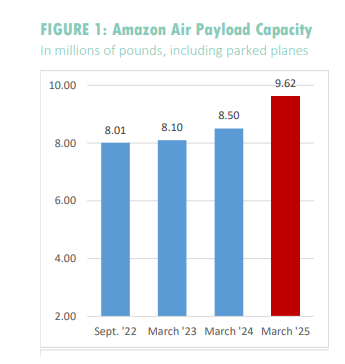
Key highlights from the Chaddick Institute's analysis include:
- Fleet Modernization: Amazon Air's US-based fleet saw a 14% rise in tonnage capacity and a 12.9% boost in volume capacity between March 2024 and 2025. The airline now operates ten Airbus A330-300 freighters-seven added in the past year-offering 17% higher tonnage and 6% greater volume capacity compared to its Boeing 767-300s. Over 75% of Amazon's domestic ton-miles are now allocated to widebody aircraft, marking a significant shift from 2021 levels.
- Nocturnal Expansion: Nighttime operations (11 PM–6 AM) surged by over one-third in the US, with nocturnal flights accounting for 39% of domestic activity in early 2025, up from 30% in 2023. Hubs like Cincinnati-Northern Kentucky International Airport (CVG) and California's San Bernardino International have become focal points for long-haul and overnight flights.
- Network Optimization: Amazon Air reduced its operational airports by five since mid-2023, consolidating around strategic hubs. Texas's Ft. Worth Alliance Airport emerged as the second-busiest location, while CVG remains central to widebody operations. Short-haul flights under 400 miles now represent just 5.1% of US routes, down from over 10% in 2022, as trucks handle shorter deliveries.
- European Retreat: Amazon Air's European presence has shrunk to 12 daily flights (excluding Saturdays), operated by ASL Ireland using Boeing 737-800s. The carrier avoids hub development, instead focusing on point-to-point flights within the Golden Triangle (Amsterdam, Frankfurt, Paris), where two-thirds of regional freight is concentrated.
Strategic Shifts and Uncertainties:
Amazon Air is terminating its partnership with Atlas Air, with most Atlas aircraft reassigned to other operators. The status of nine remaining Atlas planes (primarily Boeing 737s) remains unclear. However, contractors like ABX Air (part of ATSG Group) and newcomer 21 Air continue operations.
Globally, capacity grew 13% year-over-year and 18% since 2023, driven by US fleet expansion. Excluding parked aircraft, global capacity rose 6.6%. Larger aircraft enable Amazon to capitalize on inbound bulk cargo to busy hubs, addressing imbalances in outbound shipments.
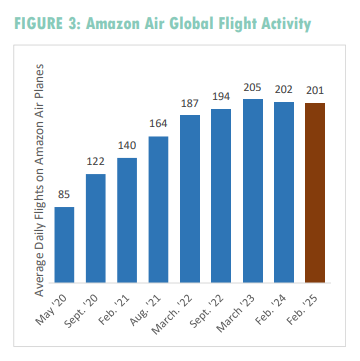
The optimizations position Amazon Air to streamline logistics, reduce costs, and strengthen its third-party shipping services, particularly for high-volume cargo.