


Fifth-ranked Giant: Net Profit Down 94.4%, Facing Challenges
Nov 14, 2023
Leave a message
A few days ago, Hapag-Lloyd released its unaudited financial results for the first three quarters of 2023.
In the first three quarters of 2023, Hapag-Lloyd carried 8,916,000 TEUs of containers, a year-on-year decrease of 71,000 TEUs or 0.8%; the average single-container freight rate of US$1,604, a year-on-year decrease of US$1,334 or a decrease of 45.4%; realized operating income of US$15.312 billion, a year-on-year decrease of 46.2%; EBITDA was US$4.519 billion, down 72.9% year-on-year; EBITDA reached US$2,989 million, down 80.3% year-on-year; and net profit reached US$3,425 million, down 76.6% year-on-year. EBITDA margin reached 30% in the first three quarters of 2023, and EBIT margin reached 20%.
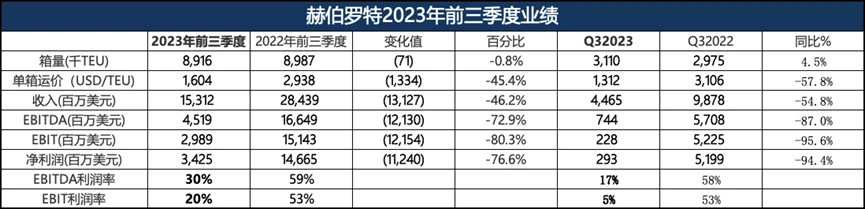
In the third quarter of 2023, Hapag-Lloyd carried 3.110 million TEU of containers, up 4.5% year-on-year; the average unit container freight rate was $1,312, down 57.8% year-on-year; operating income of $4,465 million was realized, down 54.8% year-on-year; EBITDA was $744 million, down 87.0% year-on-year; EBIT was $228 million, down 95.6%; and net income amounted to $293 million, down 94.4% year-on-year. 2023 Q3 EBITDA margin reached 17%, and EBIT margin reached 5%.
Hapag-Lloyd said these results were significantly below the previous year's level due to the severe change in market conditions. With the further expansion of its terminal business, the Hapag-Lloyd Group's business activities were also divided for the first time into the Liner Shipping and Terminals & Infrastructure divisions.
Liner Shipping Segment Results
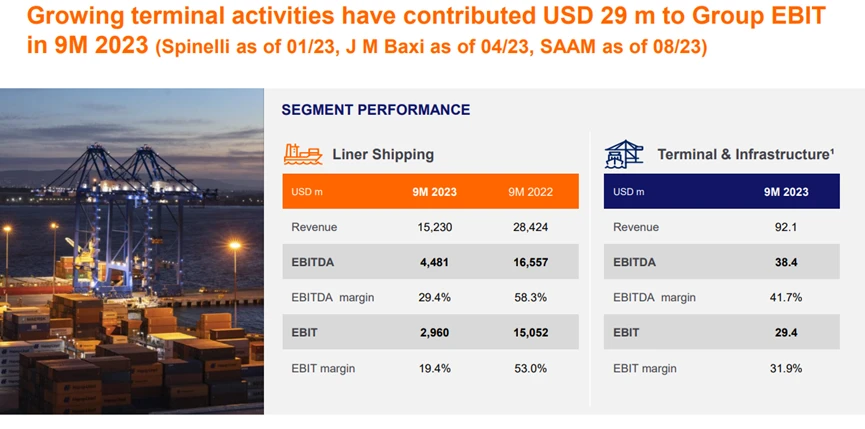
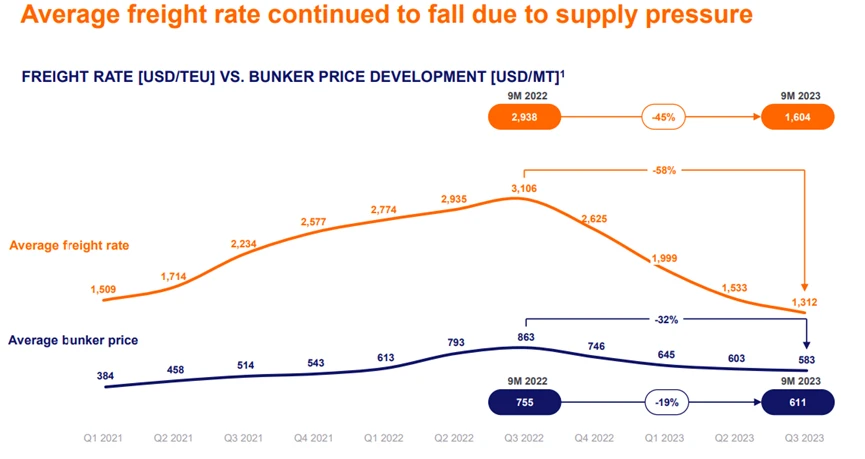
In the first three quarters of 2023, the liner shipping segment's EBITDA decreased to USD 4,481 million, EBIT decreased to USD 2,960 million, and operating income decreased to USD 15,230 million, mainly due to a lower average freight rate for a single container to USD 1,604. In the third quarter of 2023, the average freight rate for a single container decreased further to USD 1,312. In contrast, freight volumes improved in the third quarter to 3.11 million TTEUs. As a result, freight volumes in the first three quarters of the year were almost at the same level as in the same period the previous year.
Terminals and Infrastructure Sector Performance
In the Terminals and Infrastructure segment, revenues for the first three quarters of 2023 amounted to USD 92.1 million, EBITDA to USD 38.4 million, EBIT to USD 29.4 million and EBIT margin to 31.9%. The new division, which is still in the process of being formed, includes Hapag-Lloyd's stake in 20 terminals in Europe, Latin America, the United States, India, and North Africa, as well as other infrastructure.
Rolf Habben Jansen, CEO of Hapag-Lloyd, said, "Due to the increase in freight volumes in the third quarter, the first three quarters were essentially flat compared to 2022. At the same time, Hapag-Lloyd continues to focus on its 'Strategy 2030' by expanding its portfolio of terminal assets and increasing customer satisfaction once again through quality improvements.
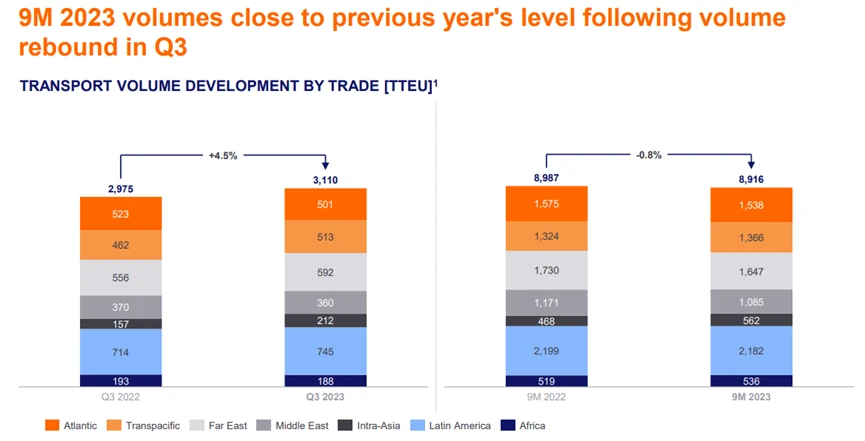
However, freight rates were significantly below the previous year's level and, as expected, declined again in the third quarter, which was reflected in a significant drop in revenue. In response, Hapag-Lloyd is working on further cost reductions. Nevertheless, if spot freight rates do not recover, Hapag-Lloyd could face some challenging quarters in this depressed market environment."
Hapag-Lloyd has lowered its earnings forecast, with a gradual normalization of the earnings trend for fiscal 2023. EBITDA is expected to be between USD 4.5 and 5.5 billion (EUR 4.1 and 5.0 billion), and EBIT is expected to be between USD 2.4 and 3.4 billion (EUR 2.2 and 3.1 billion). However, this forecast is subject to uncertainty given the many geopolitical conflicts, ongoing inflationary pressures, and continued high inventory levels at many customers.
According to the latest data from Alphaliner, Hapag-Lloyd is ranked No. 5 among the top 100 global liner shipping companies in terms of capacity, operating 266 vessels with a total capacity of 1,965,800 TEUs, of which 122 are owned and 144 are chartered. At the same time, Hapag-Lloyd holds 12 new building orders for about 252,000 TEU.