


Shipping Companies: Stop Receiving Cargo To And From Israel.
Dec 18, 2023
Leave a message
A few days ago, a number of merchant ships were attacked, increasing tensions in the Red Sea, and after shipping giants Maersk and Hapag-Lloyd on the 15th, on the 16th, two more important shipping companies, MSC and CMA CGM, announced that they would suspend sailings through the Red Sea Straits due to Yemen's Houthis attacking the area in question.
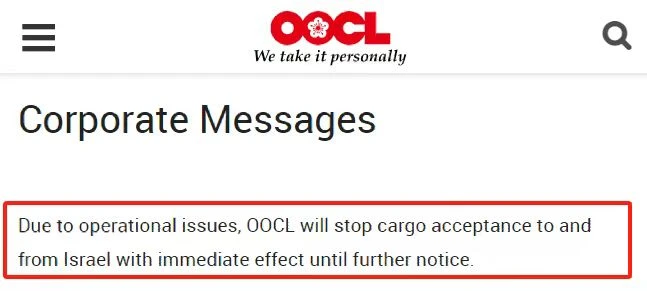
A few days ago,OOCL announced that, due to operational problems, it would immediately stop receiving cargo to and from Israel until further notice.
The International Chamber of Shipping condemned the Houthi attacks, saying they "threaten the lives of innocent seafarers and the safety of merchant ships." The organization noted that shifting shipping between Europe and Asia from the Red Sea to the Cape of Good Hope via South Africa would increase costs and cause delays. The consulting firm S&P Global estimated that the detour would increase the distance between Rotterdam, the Netherlands, and Singapore by 40 percent.
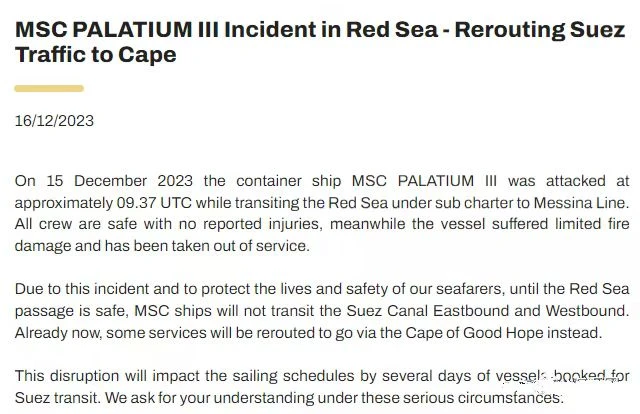
MAC, the world's largest shipping company, said one of its container freighters was attacked in the Red Sea on December 15 and that it would suspend its voyages in the Bab-el-Mandeb Strait until it was safe to do so.
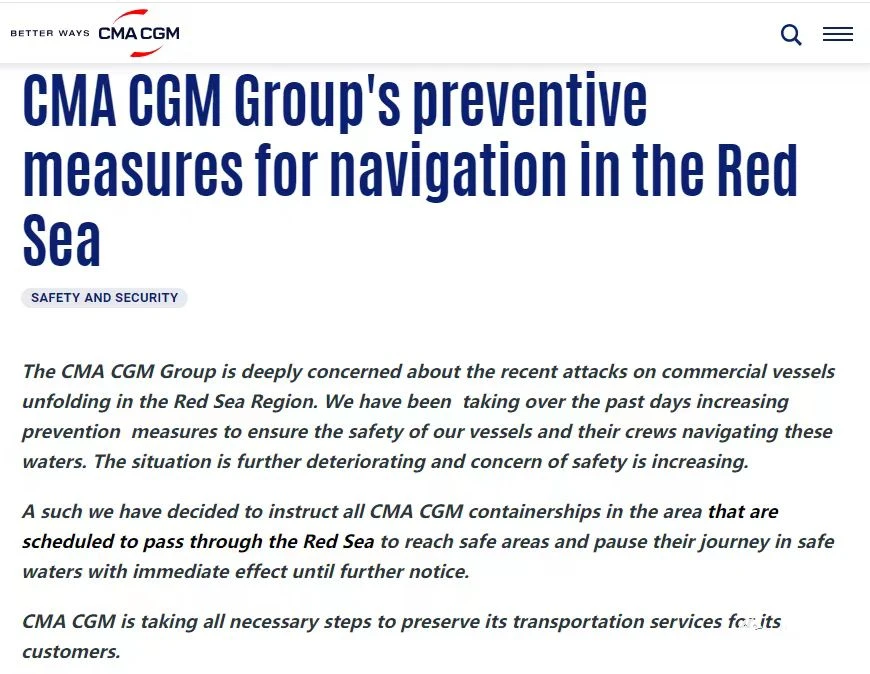
CMA CGM said it had ordered all its vessels to sail away from the area and stay there until further notice. The situation continues to deteriorate, and there are growing concerns about security," the company said.
Danish container carrier Maersk also said earlier that all its vessels in the region bound for the Bab-el-Mandeb Strait would be suspended until further notice. In addition, German ocean carrier Hapag-Lloyd will suspend all container ship traffic through the Red Sea until Monday (Dec. 18), with a decision to be made thereafter.
Maersk's Danish shares jumped 7.9%, and Hapag-Lloyd's German shares jumped 16.4%, mainly in anticipation that the disruption to shipping would help reduce the oversupply of shipping capacity.
The Bab-el-Mandeb Strait is strategically important as it connects the Red Sea to the Gulf of Aden. The Israeli-Palestinian conflict will disrupt the global supply chain through the Red Sea and the Suez Canal, which accounts for 30 percent of global container shipping and is a key shipping lane for crude oil shipments.
The conflict comes at a difficult time for the global supply chain, with the drought in the Panama Canal already causing significant delays to shipping and the disruption of the Red Sea route, which will impact all parts of the supply chain from producers to end-users and increase the likelihood that key commodities will not reach their destinations in time for Christmas, said Fogoni, director-general of the Institute of Export and International Trade.