


The Conflict Continues To Escalate! Shipments Are Affected! Latest Notice Of Shipping Company
Oct 23, 2023
Leave a message
According to data from the Palestinian Ministry of Health and the Israeli Ministry of Health, a new round of clashes between Palestine and Israel has killed more than 5800 people on both sides. Israeli air strikes against Hamas continued on the 21st local time. At the same time, Hamas is responding by firing rockets.
Shaul, executive chairman of the board of directors of the port of Ashdod, said that the Israeli port of Ashdod is one of the largest ports in the country and an important asset of the national economy, and continues to operate normally despite the ongoing conflicts between Israel and Hamas.
However, as the conflict spreads, there may be potential risks, the backlog of ships in Israeli ports is increasing and war insurance rates are soaring.
According to foreign media, although most of the terminals are still in operation, the backlog of ships in Israeli ports is increasing, and it is worth noting that Israel faces heavy rocket attacks, including in the south of the country, which led to the closure of the port of Ashkelon, which is closest to Gaza. In addition, the port of Ashdod imposed restrictions on the transport of dangerous goods, which meant that transport was affected to a certain extent.
However, the impact of the conflict on container freight rates to and from Israeli ports remains important. Shaul, executive chairman of the board of directors of Port Ashdod, estimated the possible trend of container rates at the port. It believes that shipping companies will not raise freight rates in Ashdod and so far have not seen any increase in freight rates, surcharges or additional charges. However, it expressed concern about the possible increase in insurance costs.
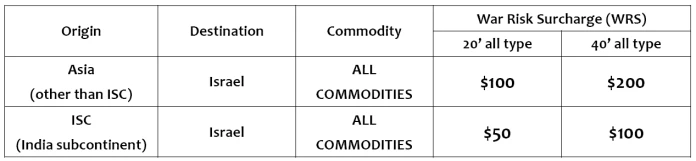
South Korean shipping company HMM has announced a war risk surcharge (WRS) on Israeli goods in a customer consultation on October 18th.
"as costs increase due to deteriorating conditions to and from Israel, customers must be informed that I will immediately implement WRS on all types of containers to maintain services to and from Israel," HMM said in the announcement.
The WRS of HMM is effective immediately until further notice, as follows:
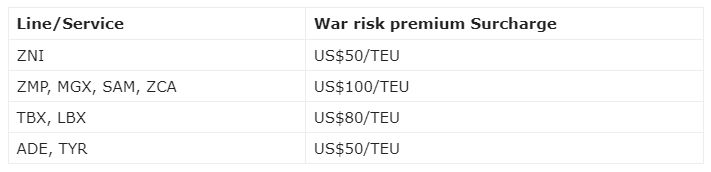
ZIM, an Israeli container shipping company, also announced additional charges. "in view of the war situation, insurance companies impose additional war risk premiums on all ships calling at Israeli ports, which we are now obliged to pay to maintain services to and from Israel," the company said in its latest notice.
ZIM has decided to impose the following new war risk premiums (WRP) on goods entering and leaving Israel, effective October 12.
A few days ago, Evergreen Shipping announced that its 1778TEU "Ever Cosy" had encountered force majeure and could not stop at the Israeli port of Ashdod as planned and diverted to Haifa. The company said the situation was beyond its control and that all shipments to Ashdod had been unloaded in Haifa, adding: "after that, the main contract of carriage is deemed to be terminated and all liability of the carrier will be terminated." (Israeli port, shipping company declares force majeure)
The company told customers: "in order to protect your interests and minimize your costs, we sincerely recommend that you pick up the goods at Haifa Port as soon as possible." If necessary, we recommend that you contact the freight insurance company for assistance. "
Maersk issued the latest announcement that although it currently accepts bookings to and from Israel. However, for dangerous goods, both Haifa Port and Ashdod Port impose restrictions on specific goods.
Maersk said it waived the change of destination (COD) fee and the demurrage fee (Detention) and demurrage fee (Demurrage) suspended at all ports in Israel until November 8. According to the latest announcement from MSC Mediterranean Shipping, Israel's main ports continue to operate, including the main terminals in Ashdod and Haifa, but due to increased security checks and labor shortages, Ashdod is currently congested, resulting in an increase in waiting time.
Therefore, bookings to and from Israel will continue to be accepted, and booked goods to and from the country will be serviced as planned. However, some dangerous goods (DG) cannot be released at the port of Ashdod, so dangerous goods cannot currently be booked. If the affected goods are already in transit, a contingency plan will be made to unload the goods at other ports and the customer will be informed of any changes in the destination of the goods. In addition, Hebrot's official website announced a few days ago that in view of the situation in Israel, the port has imposed restrictions on the acceptance of dangerous goods to and from Ashdod and Haifa, so Hebrot will no longer accept dangerous goods bookings between Ashdod and Haifa.
Conflict escalation-potential risks
At present, it has not been seen that the conflict between Israel and Hamas has caused difficulties to global trade. However, the escalation of the conflict could pose challenges to key waterways.
Christian Roeloffs, co-founder and CEO of Container xChange, an online container logistics platform, explained: "in the event of a conflict in Israel, any extension of hostilities outside the country could pose a risk to two important shipping congestion points. The Suez Canal is an important waterway for all kinds of merchant ships, including container ships, and may face disruption. Similarly, the Strait of Hormuz, the backbone of oil and gas transport, may also be affected. However, the extent of these impacts depends to a large extent on the expansion and duration of conflicts. "
On the other hand, Israel's container transport market is relatively small, with its main ports Ashdod and Haifa accounting for only 0.4 per cent of global throughput, so the threat of disruption of container trade flows in the Mediterranean remains limited. Analysis of Container xChange.
Port strives to maintain normal operation
Shaul, executive chairman of the board of directors of Port Ashdod, pointed out that the employees of Port Ashdod continue to maintain operational continuity in the Israeli economy and work faster, and they understand the importance of maintaining normal port operations.
The port of Ashdod, the only state-owned port in Israel, operates 24 hours a day and operates 24 hours a day, with long shifts for two main reasons. The first reason is their own safety. It says it is safer for port employees to stay in the port area than to go home on the way.
In addition, the Israeli military has recruited 10% of the personnel of the Ashdod Port Company, so the remaining personnel must fill the vacancy.
With regard to the special measures and guidelines that Israeli ports may receive from the government, Shaul said that there are no special provisions in the port of Ashdod. "In this case, we are trying to maintain normal operations." he said. The port is in contact with shipping companies, which are still transporting goods through the port without any major disruption.